Showing posts with label virtual classroom assignment. Show all posts

Tuesday, May 1, 2012

Hey there, Allen!


There are many similarities between Allen and Walt.  Rightly so since I read that Allen wanted to be the poet to continue Walt's voice.  First off, the very obvious similarity would be that they both use the free verse form.  Allen's use of free verse seems more like paragraph prose though.  In Part I, the listing of the types of individuals in which he starts with who, are so descriptive and long.  Speaking of the "who", the individuals Allen speaks of, reminds me of Song for Occupations in which Walt lists all the types of jobs he is familiar with.  Not only are both these poets using this form of free verse, but they love lists.  They are listing people/jobs that they are familiar with.  If you really think about it, these are the jobs and people of America.  These are the real people, not just images of what America could be or should, but I think their image of the America person is a reality and shows a vulnerability, especially Allen's description.

Now I'm not sure if this is a similarity or difference, especially because of all the changes Walt made through his different editions of Leaves of Grass.  The way that both poets are trying to get their message across, the words they use, the things they describe are not censored, especially Allen.  The only reason I would think there is a difference is because Walt took multiple lines about people of color out from Song of Occupations as the editions of Leaves of Grass was published.  It doesn't seem like Allen did this, but I haven't researched that.  However, he does not feel the need to censor himself.  Instead he lets it all hang out.  He says, "who let themselves be fucked in the ass by saintly motorcyclists" and "...a vision of ultimate cunt and come eluding the last gyzym of consciousness" and "with dreams, with drugs, with waking nightmares, and alcohol and cock and endless balls."  Speak on Allen! Say what you gotta say!  He definitely could have used less explicit words, but fuck it, those are the words that he needed to use to get his point across.  Yes, they both wrote in COMPLETELY different times, but then tell me why Walt removed those parts about colored people.  I think he was censoring himself.

Wednesday, April 25, 2012

MURIEL!


Well, I'm glad I read about the Hawks Nest Tunnel Disaster prior to reading the poem or else I would haven't known about that.  That being said, the speaker of the poem, it seems, is trying to steer the reader in a certain direction.  Just looking at the first five stanzas, there is a lot of talk about roads, cities, places to go, things to do, as if the speaker is telling the reader where to go, what to do.  Knowing about the Hawks Nest Tunnel Disaster it makes perfect sense.  Muriel specifically says, "This is a nation's scene and a halfway house."  She calls it a halfway house!  She uses the word "you" and "your" a few times in the first five stanzas as well.  I think this establishes a relationship that says that the speaker is speaking for the reader, as if it were the reader's own thoughts.  Or maybe the speaker is going so far as to persuading the reader that this is what they are thinking by saying "you" and "your."  Unlike Walt's poem, "When Lilacs Last in the Dooryard Bloom'd", Murile uses the words "we" and "us."  Walt uses the word "I" a lot, thus separating the speaker and the reader.  The ending of Muriel's poem seems pretty positive considering that one stanza that goes, "all these men cry their doom across the world, meeting avoidable death, fight against madness, find every war."  She uses words such as open, desire, beginning, and ends the poem with unending love.  I think this speaks to some sort of feeling of regeneration or at least that one can occur if people are open to it.  Interesting how this poem is about the Hawks Nest Tunnel Disaster when just about a year later World War II happens.  I think you could almost read parts of this poem as a WWII poem.

Sunday, April 1, 2012

What am I going to do?!


Since I have decided to pursue the changes Walt has changed throughout the different editions of Leaves of Grass, I'm going to have to do more research.  I've decided to stick with the poem Song for Occupations since I am familiar with that, and I also really liked it.  Some questions that I have in mind that I would like to find the answer to, how much influence did publishers have on Walt?  Did he really want to make all those changes?  And for what purposes were those changes made?  There will never be a set answer just because I can't ask Walt himself, unless a Oiji board really does work and will allow for a long explanation.  But I think the research would be quite interesting.  I would obviously read more Specimen Days posts as well as do more research on America at that time and the publishers.  I'm sure Walt did what he wanted with his poems but at the same time you can't help but think his readers influenced him somewhat.

Now, the main question. How am I going to present this?!  There are two ways that I was thinking about, a story or a set of poems.

For the story, I was going to write a narrative with either a reader during Walt's time or a publisher.  If these people read Leaves of Grass in the 1860's and saw the changes right then and there, what was their reaction and even interaction with other people and Walt himself!  That is more of a creative writing assignment, one in which fiction would come into play.

The second being a set of poems.  I'm not much of a poem writer but have been writing silly ones with a friend of mine.  I thought that maybe I could do the opposite of Walt.  He was so into free verse, no constraints!  I could present evidence through poems with some sort of rhyme and meter.  I have never really done anything like this before, unless you consider rhyming cat and hat and bat and mat in high school.

Wednesday, March 28, 2012

Project to Develop

I have decided that I would like to develop the project in which we tracked the poem Song for Occupations throughout the different editions of Leaves of Grass.  Maybe I could track more than just Song for Occupations and come up with my own conclusion as to why Walt made these changes.  There are so many reasons as to why he made changes.  Was it the publishers?  Was it his own personal views? Was it that America was changing and so were the people reading his poems?  Why couldn't he just leave it the way it was?  I would have to figure which poems I would be tracking and do additional research about the questions that have been asked.  I think it would be wise of me to use the Whitman archives website as well as Specimen Days.  The thing about this is that no one will ever know the real reason, but then again that is the fun part! Speculate and come up with my own hypothesis!!

Friday, March 9, 2012

Walt in the NOW!


After searching for quite some time on Walt in popular culture, I came across these three items.

I found that Walt, like many other writers and even just famous people, have their quotes put across some sort of landscape picture.  Anyone can put a quote over a picture!  But this picture is by far my favorite!  It makes reference to Walt's form of poetry.  I read somewhere that Walt is known as the father of free verse, so this picture is not only true, but witty, OR should I say, whitty. Plus, the dog is wearing glasses.  Extra funny points for that.  I have no clue why, but its funny to me!


Upon my search, I found this comic strip by Stephan Thomas Pastis who is the creator of a syndicated comic strip called "Pearls Before Swine"  which runs in hundreds of newspapers around the world.  I came across a particular comic about Walt and Twitter!  It talks about Walt's poetry in relation to twitter.  His sentences and much of his poems were so long that you probably can't fit a lot of the lines in 140 characters or less.  Imagine if Walt did tweet.  He would have abbreviated everything!  Plus, 140 characters is limiting what Walt needed to say.  I don't think he would've liked having limitations for expression.


Lastly, I FOUND WALT WHITMAN BEER!!!!! Or well it is called Walt Wit, but it's beer! And his portrait is on the bottle!!  The Philadelphia Brewing Co has a beer dedicated to him.  The description of the beer goes like this:

"The American poet, Walt Whitman, once portrayed a sunset over Philadelphia as "...a broad tumble of clouds, with much golden haze and profusion of beaming shaft and dazzle". Pour yourself a bottle of Walt Wit Belgian-Style White Ale and see what he was talking about. A pinch of spice and a whisper of citrus lend complexity to this fragrant and satisfying ale.
Walt Wit - It's Transcendentally Delicious."

Wasn't it in "Song of Myself" where he wanted the reader to taste him?  "You settled your head athwart my hips and gently turned over upon me.  And parted the shirt from my bosom-bone, and plunged your tongue to my barestript heart" (3).  Whoa!  So by drinking this beer, you really do get a taste of Walt?


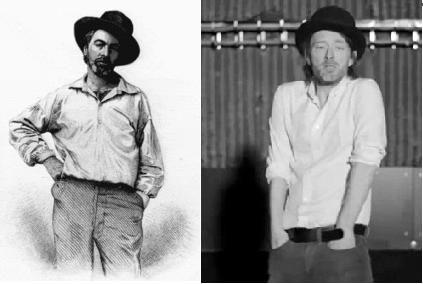
So those are my fun findings of Walt in popular culture.  But I leave you with this photo.  Walt and Thom Yorke...TWINSIES!!!


Wednesday, February 29, 2012

Walt's (changing) Times


Throughout "A Song for Occupations" (1855), Walt's view of work is not what work is being done but what the result of the work is and how the individual goes about it.  He really hones in on equality in the workplace as well as at home, "If you bestow gifts on your brother or dearest friend, I demand as good as your brother or dearest friend."  That might seem like it is Walt asking for more, but throughout the poem he makes it clear that everyone should be looked at and treated equally.  He has a couple lines on page 46 of the 1855 edition that state, "Not only the free Utahan, Kansian, or Arkansian....not only the free Cuban....not merely the slave....not the Mexican native, or Flatfoot, or negro from Africa...Grown, half-grown and babe - of this country and every country, indoors and outdoors I see....and all else is behind or through them."  He describes people of all walks of life and begins the stanza by saying, "I see not merely that you are polite or whiteface..."  He doesn't care about what you look like or where you come from.  He sees further than that and I think that speaks to equality in not just the workplace but in society as well.

Through the six editions of Leave of Grass, Walt makes A LOT of significant changes that when reading through each, it gives the poem a different meaning.  By the 1891 edition, I didn't feel like he was addressing the public as a whole.  Instead I feel like he was addressing more upper class, scholarly individuals.  Take for example the lines I used in the above paragraph where he mentions the Cubans, Mexicans, slaves, and Native Americans.  He removes that entire part in the 1860 edition and never adds it back in.

In the 1856 edition, he titles the poem, "Poem of the Daily Work of the Workmen and Workwomen of These States."  He removes ellipses, semi colons, and dashes to replace them with commas.  He hyphenates words such as ship-carpentering, glass-blowing, and iron-works when they were once just one word.  He added the line about coal-mines, oakum, brewing, cheap literature, and coins and medals.  With these additions, Walt may have been catering to his audience as a whole society, upper and lower class combined, more than the 1855 edition since there were more additions than subtractions.

In the 1860 edition, he titles the poem, "CHANTS DEMOCRATIC 3."  I find it appropriate that he uses the word democracy since he has a line in the poem that goes, "The president is up there in the White House for you....it is not you who are here for him."  The land is a democracy.  He also addresses America as a whole by adding "Male and Female!", "American masses!", and "Workmen and Workwomen!" in the 3rd, 4th, and 5th stanzas.  As mentioned this edition is where he removes the lines about the Native Americans, slaves, negros from Africa, etc.  Basically he removes all lines about equality to people who are not of a European decent.  That's putting it nicely.  Real talk, he takes out the lines about people of color! Instead he adds, "Eminent in some profession, a lady or gentleman in a parlor, or dressed in the jail uniform, or pulpit uniform."  What?  Did Walt mean to replace one line with the other?  Let us hope not because that would mean he thinks people of color should be dressed in jail uniforms!!! Stereotypes, Walt, stereotypes.  Anyways.  Who knows why he did that.  Oh, he also changes the word SATURDAY to Seventh Day night which is interesting because that a very Protestant move since the Saturday is the seventh day of the Judeo-Christian week.

In the 1867 edition, he titles the poem, "TO WORKINGMEN."  Here Walt moves the poem from the beginning of Leaves of Grass to the middle.  In previous editions it was always in the beginning.  He gets all fancy with his grammar by saying learn'd instead of learned and adds the line, "List close, my scholars dear!"  Now that might mean he is targeting scholars or that he believes ALL people who read are scholars.  He does more removal of lines, one to notice is the description of the ankle chain slave which after reading the poems, no longer addresses people of color.  What does that say about his target audience OR the publishers?  Maybe the publishers are telling him to remove all of that!  A significant change in this poem is that he moves the last stanza that starts with "When the psalm sings instead of the singer..." to the middle of the poem.  In all other editions it was at the end, which I have to say, I think it flowed better and gave the poem a nice summary.

In the 1871 edition, he calls the poem, "CAROL OF OCCUPATIONS."  Very little is done to this edition compared to the last.

In the 1881 edition, he goes back to the original title, "A SONG FOR OCCUPATIONS."  He even calls it a song in the poem.  He changes the entire first stanza and no longer addresses the people as "lovers" advising them to come in and listen to him.  Instead he is boring!  He just says, "this is what I have found."  It is more of a poem of what he has found than a poem of what he KNOWS!  But most importantly, he moves the stanza that begins with "When the palm sings instead of the singer..." back to the end of the poem and personally I think to it's rightful place.

I found no significant changes made to the 1891 edition. He obviously felt it was fine just the way it was in 1881.

I think by 1891 Walt sold out!  His poem wasn't for the people anymore. While reading through each edition, I began to feel like it was more for the people in offices rather than the actual workmen and workwomen.  His first edition was all about the people, doing this in THEIR time.  There is one line that stays throughout the editions, "In folks nearest to you finding also the sweetest and strongest and lovingest, Happiness not in another place, but this place..not for another hour, but this hour..."  Not only did this remind me of the movie, "The Goonies", but his idea of "this place" changes as he revises the poem.  But then again, maybe that was just America changing and Walt was changing with it.

Speaking of "The Goonies", I leave you with this!!!


Monday, February 20, 2012

Revisions


Since I have only really read the Preface and Song of Myself in the 1855 edition of Leave of Grass, those two are the main differences I see when comparing the 1855 edition and 1860 edition.  Obviously Walt felt the need to make some major changes in those five years.  The 1855 edition has a really long preface in which, long story short, he talks about America and poetry.  I read over Proto-Leaf and it seems to me that he cut out the preface and replaced it with Proto-Leaf.  The themes of the two are very similar and I think the message Walt is trying to convey is the same.  Proto meaning first, it is obviously the first poem, but I find it interesting that he no longer leaves it as the preface, what seems to be a free write essay for him.  He changes it into a poem.  This poem similarly addresses America and poets.  Take stanza 13 in the 1860 edition for example, "Take my leaves, America! Make welcome for them everywhere, for they are your own offspring." As well as stanzas 17-18, "Here lands female and male, Here the heirship and heiress-ship of the world...Yes here comes the mistress, the Soul.  The SOUL!"  I think this goes along with the preface of the 1855 edition, "Of all mankind the great poet is of equable man.  Not in him but off from him things are grotesque or eccentric or fail of their sanity.  Nothing out of its place is good and nothing in its place is bad.  He bestows on every object or quality its fit proportions neither more nor less...He is the equalizer of his age and land....he supplies what wants supplying and checks what wants checking" (preface, pg v).  He still keeps to the same theme is both which doesn't really mix it up that much, but the fact that he changes the way his message is written says something else.  I think it speaks to the uniformity of the book.  A preface is a preface, it is an introduction to a book.  I don't know about people in the 1860's, but I know a few people, myself NOT included, that skip introductions and prefaces.  Oh what? These aren't even real numbers? They're just ROMAN NUMERALS?! SKIP! So many people skip that beginning because they feel it will just be addressed in the book and might not be important.  I think Walt knows that he says, "Fuck that! ALL of my writing is important and should be read!"  Preface is no longer an introduction, it is the first poem of Leaves of Grass.  It is a poem AND it has real page numbers! No one will skip over it anymore!  The second difference I see is that he renamed Song of Myself to Walt Whitman.  Now, one can think, how self involved must this guy be if he wrote a poem after himself?!  I actually like the change.  It was easy to see that Song of Myself was going to reflect Walt's own vision and beliefs, but changing the name to Walt Whitman makes his beliefs more firm.  It's like he is more confident with the poem the second time around.

On pages 50-53 of the blue book, Walt makes a lot of changes, not just to capitalization of letters, grammar, and punctuation, but to the addition and subtraction of full on lines.  On page 51 he removes a stanza consisting of 2 lines, but still a stanza!  On page 52 he writes a new stanza that he thinks he could include then later crosses it out and it never makes it to the 1867 edition.  On page 53 he adds a new stanza that I think is a nice addition.  He says, "It alone is without flaw-it rounds and completes all; That mystic, baffling wonder I love, alone completes all."


UPDATE:  I just read Whitman's biography.  It seems that "Proto-Leaf" was previously "Starting from Paumanok" and not the preface. :( bleh. Oh well, I'm still sticking to what I said.

Tuesday, February 7, 2012

The Voice


The sound a person makes or their own personal expression can be defined as a voice.  People often refer to their voice as their own opinion, something that they identify as their own individual values and beliefs.  One such person could say that they were just "voicing their opinion."  There are many different ways the word voice can be looked at.  Whitman does just that in "Song of Myself."  Not only does he use the word voice as a way to express the speakers opinion but he uses it both directly and indirectly.  An individual's speech or vocal expression is discussed throughout the poem.  He says, "I do not ask the wounded person how he feels, I myself become the wounded person" (27).  This speaks to Whitman's acceptance of others.

Here are all the instances in which Whitman uses the motif voice in "Song of Myself."

"Through me many long dumb voices,
Voices of the interminable generations of prisoners and slaves,
Voices of the diseas'd and despairing and of thieves and dwarfs,
Voices of cycles of preparation and accretion,
And of the threads that connect the stars, and of wombs and of the
father-stuff,
And of the rights of them the others are down upon,
Of the deform'd, trivial, flat, foolish, despised,
Fog in the air, beetles rolling balls of dung.
Through me forbidden voices,
Voices of sexes and lusts, voices veil'd and I remove the veil,
Voices indecent by me clarified and transfigur'd." (17)

"My voice goes after what my eyes cannot reach" (19)

"I heard the sound of the human voice....a sound I love" (19)

"Pleased with the quakeress as she puts off her boneet and talks melodiously" (25)

"My voice is the wife's voice, the screech by the rail of the stairs" (26)

"I take part....I see and hear the whole,
The cries and curses and roar....the plaudits for well aimed shots" (28)

"I laughed content when I heard the voice of my little captain,
We have not struck, he composedly cried, We have just begun our part of the fighting" (29)

"The husky voices of the two or three officers yet fit for duty" (30)

"Minding their voices peal through the crash of destruction" (34)

"My own voice, orotund sweeping and final" (34)

"You are also asking me questions, and I heard you;
I answer that I cannot answer....you must find out for yourself." (40)

"I do not say these things for a dollar, or to fill up the time while I wait for a boat;
It is you talking just as much as myself....I act as the tongue for you,
It was tied in your mouth....in mine it begins to be loosened" (41)

"The farmboy ploughing in the fields feels good at the sound of my voice" (41)

"Toss to the moaning gibberish of my dry limbs" (42)

"I too am not a bit tamed....i too am untranslatable
I sound my barbaric yawp over the roofs of the world" (43)


Comments:
"I heard the sound of the human voice....a sound I love" (19)
This is one of my favorite times he talks about the voice.  Maybe it is because I can relate or maybe it is because I like the way the line sounds.  In this stanza, Whitman describes the sounds around him.  The beautiful music of the birds, the sounds of the city, alarms, fires, etc, but the sound that he loves the most is the sound of a human voice.  This could go both ways - the fact that he loves that people are expressing their opinions or maybe it has to do with just the sounds of people's voices, they are communicating, talking, conversing.  When people are talking they are doing something, they aren't just sitting around being a bum which I think is one of the Whitman's biggest beliefs about life.

"You are also asking me questions, and I heard you;
I answer that I cannot answer....you must find out for yourself." (40)
Along with the word "voice", Whitman uses the voice in other ways.  He doesn't specifically say "voice" but in these lines it is like he is telling the reader to voice up, ask around, "find out for yourself."  There is more to life than just asking questions, there is an exploration aspect.  As mentioned in the previous comment, Whitman doesn't think people should be stagnant, they need to move about.  While Whitman says he loves the human voice, I think he wants people to use it wisely.

""I too am not a bit tamed....i too am untranslatable
I sound my barbaric yawp over the roofs of the world" (43)
Towards the end of the poem, Whitman says this.  A barbaric yawp, I think referring to a loud expression, maybe a scream.  Either way, this sums up the two previous quotes I mentioned.  He wants people to talk, he wants people to explore, and all the while, he wants people to freely express themselves.  He says that he is untranslatable, his words cannot be translated.


The idea of the voice helps to articulate his idea about both the self and probably the poet.  After reading all this, it is almost as if he is preaching, telling people to speak up, get out, and explore!  Maybe he is telling himself to do the same thing and he is doing so with this poem.

Tuesday, January 31, 2012

Specimen Days: Ferries

"MY PASSION FOR FERRIES"

After scrolling, this entry seemed the most interesting especially since I too enjoy a nice ferry ride.  It seems though not as much as Mr. Whitman.  The one thing I noticed was the lists.  This entry is a list of things: scenery, people, and images.  The people he knew, the things he saw while on the sea, his reasons for loving ferries, etc.  He just continues to list out everything.  I noticed he does that in "Song of Myself" as well.  The list there is more descriptive.  Take for example at the top of page 18 when he says, "If I worship any particular thing it shall be some of the spread of my body."  After that, he lists of parts of his body in great detail, one line being, "You my rich blood  your milky stream pale strippings of my life."

This is what Whitman is talking about when he suggests that people shouldn't be couped up indoors and that they need to go out an explore.  One doesn't need to be in the woods to have an adventure and explore.  All he did was go on a ferry and he was about to hear "the majestic sounds boats" and see friends.  The fact that this is one of his passions also goes to show you that Whitman is a man of pleasure.  He knows what he likes he goes for it and enjoys it.

See More/Talk More

My voice goes after what my eyes cannot reach,
With the twirl of my tongue I encompass worlds and volumes of worlds.

Line after line I read, every word was interesting, but as the Bart train stopped, so did my eyes.  I read those two lines at least five times.  It wasn't because I didn't understand it, but because I wanted to understand it more.  How cheesy does that sound?!  But it's true.  I feel like Walt is constantly expressing his interest in exploring and living your own life.  The curiosity of the world excited him.  These two lines express just that.

The first line states, "My voice goes after what my eyes cannot reach."  I imagine the voice and the eyes competing, searching for something.  Obviously as humans the greatest sense we have is our sight and that goes as far as we want it to.  But when it cannot, that is where the voice comes in - asking questions, meeting new people, being open about your thoughts, your feelings.  To me, that is what he means when he says that his voice goes after what his eyes cannot.  When you think you have seen all you can see, maybe even imagined all you have imagined, speak more, talk more. "With the twirl of my tongue I encompass worlds and volumes of worlds."