Martin F. Tupper wrote Proverbial Philosophy: A Book of Thoughts and Arguments. It is a long series of didactic moralisings in blank verse and is said to be "prose cut up into suitable lengths." It epitomized the moral and evangelical spirit of the mid 19th century.
Proverbial Philosophy is similar to Leaves of Grass in that they are both written in free verse and they somewhat didactic. All of Tupper's works start with Of (some idea), "Of Truth in Things False", "Of Anticipation", "Of Education", "Of Pride." Similar to how Walt titles his poems, "Song OF myself" or "Song FOR Occupations." The title of the poem directly relates to the poem itself. That might be something just of the period, but it it shows the reader what they can expect while at the same time being direct and confident about their work. The authors, Tupper and Walt, could be using this as a strategy to preach. There is a review written anonymously that also thinks the two are similar. From "Walt Whitman's Poems." The Literary World, the critic writes, "The chaos of Mr. Whitmna's verse, to compare great with small, reminds us of the gray clay bluffs of Truro Beach. Would it were as clean! In form he reminds us of Martin Farquhar Tupper."
I also found an excerpt from "Of Education" by Tupper to be fairly similar to some thing's Walt has said. From "Of Education",
"mother, let him learn of thy lips, and be nourished at thy breast. character is mainly moulded by the cast of the minds that surround it: let then the playmates of thy little one be not other than thy judgement shall approve; for a child is in a new world, and learneth somewhat every moment, his eye is quick to observe, his memory storeth in secret..."
This reminds me of a mix between "Song of Myself" and "Song for Occupations." The description of the lips and breast remind me of the part in "Song of Myself" where he is talking about the tongue. The education of a child and how he/she grows up reminds me of "Song for Occupations."
After searching for quite some time on Walt in popular culture, I came across these three items.
I found that Walt, like many other writers and even just famous people, have their quotes put across some sort of landscape picture. Anyone can put a quote over a picture! But this picture is by far my favorite! It makes reference to Walt's form of poetry. I read somewhere that Walt is known as the father of free verse, so this picture is not only true, but witty, OR should I say, whitty. Plus, the dog is wearing glasses. Extra funny points for that. I have no clue why, but its funny to me!
Upon my search, I found this comic strip by Stephan Thomas Pastis who is the creator of a syndicated comic strip called "Pearls Before Swine" which runs in hundreds of newspapers around the world. I came across a particular comic about Walt and Twitter! It talks about Walt's poetry in relation to twitter. His sentences and much of his poems were so long that you probably can't fit a lot of the lines in 140 characters or less. Imagine if Walt did tweet. He would have abbreviated everything! Plus, 140 characters is limiting what Walt needed to say. I don't think he would've liked having limitations for expression.
Lastly, I FOUND WALT WHITMAN BEER!!!!! Or well it is called Walt Wit, but it's beer! And his portrait is on the bottle!! The Philadelphia Brewing Co has a beer dedicated to him. The description of the beer goes like this:
"The American poet, Walt Whitman, once portrayed a sunset over Philadelphia as "...a broad tumble of clouds, with much golden haze and profusion of beaming shaft and dazzle". Pour yourself a bottle of Walt Wit Belgian-Style White Ale and see what he was talking about. A pinch of spice and a whisper of citrus lend complexity to this fragrant and satisfying ale.
Walt Wit - It's Transcendentally Delicious."
Wasn't it in "Song of Myself" where he wanted the reader to taste him? "You settled your head athwart my hips and gently turned over upon me. And parted the shirt from my bosom-bone, and plunged your tongue to my barestript heart" (3). Whoa! So by drinking this beer, you really do get a taste of Walt?
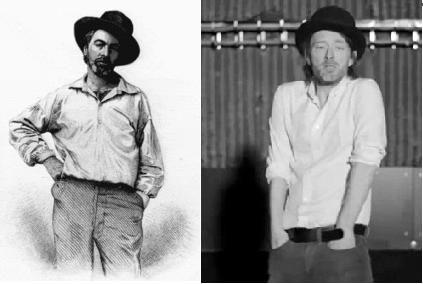
So those are my fun findings of Walt in popular culture. But I leave you with this photo. Walt and Thom Yorke...TWINSIES!!!
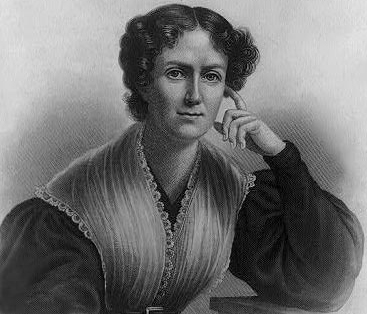
Frances Wright was a Scotland-born lecturer, writer, and abolitionist. She was the co-founder of the "Free Inquirer" newspaper and founded the Nashoba Commune where she wanted to educate slaves to prepare them for freedom. She wanted to create a community in which it was multi-racial, a community of free blacks and whites. Unfortunately, Wright became ill and the managers who took over during her illness and move back to Europe, had a stricter approach to the Commune and when she came back to Tennessee, the community had collapsed.
Her anti-slavery beliefs were interesting to Walt. He went to see her speak at the anti-slavery halls in New York. He spoke of her as, "a woman of the noblest make-up whose orbit was a great deal larger than theirs - too large to be tolerated for long by them...she touched the widest range of themes - spoke informally, colloquially. She has always been to me one of the sweetest of sweet memories: we all loved her." It seems he looked up to her. He also says of her, "She was a brilliant woman, of beauty and estate, who was never satisfied unless she was busy doing good - public good, private good." This speaks to Walt's beliefs on work which I have talked about in my past two posts! The work she was doing was for the good of the people as well as herself. She was learning more and teaching more and I think that was something that Walt was drawn to by her.
In Walt's Speciman Days post called "Growth -- Health -- Work", he talks about how he grew into a strong young man, maybe too quickly, but as time went on found the things he loved and began writing. He writes about how he worked as a compositor in printing offices in New York.
Having just read his poem, "A Song for Occupations", I wonder how much of his work in New York relates to that poem. In his Specimen Days post he says, "This latter I consider one of my best experiences and deepest lessons in human nature behind the scenes, and in the masses." I think this speaks a lot to the poem. The poem was not about the work that was being done, the manual labor, but the experience you get from it and how that makes you grow as an individual. In "A Song for Occupations" he says, "I bring not money or amours or dress or eating....but I bring as good; And send no agent or medium...and offer no representative of value - but offer the value itself." In the poem and the Specimen Days post he believes that if you do good work, you will learn from it.
Throughout "A Song for Occupations" (1855), Walt's view of work is not what work is being done but what the result of the work is and how the individual goes about it. He really hones in on equality in the workplace as well as at home, "If you bestow gifts on your brother or dearest friend, I demand as good as your brother or dearest friend." That might seem like it is Walt asking for more, but throughout the poem he makes it clear that everyone should be looked at and treated equally. He has a couple lines on page 46 of the 1855 edition that state, "Not only the free Utahan, Kansian, or Arkansian....not only the free Cuban....not merely the slave....not the Mexican native, or Flatfoot, or negro from Africa...Grown, half-grown and babe - of this country and every country, indoors and outdoors I see....and all else is behind or through them." He describes people of all walks of life and begins the stanza by saying, "I see not merely that you are polite or whiteface..." He doesn't care about what you look like or where you come from. He sees further than that and I think that speaks to equality in not just the workplace but in society as well.
Through the six editions of Leave of Grass, Walt makes A LOT of significant changes that when reading through each, it gives the poem a different meaning. By the 1891 edition, I didn't feel like he was addressing the public as a whole. Instead I feel like he was addressing more upper class, scholarly individuals. Take for example the lines I used in the above paragraph where he mentions the Cubans, Mexicans, slaves, and Native Americans. He removes that entire part in the 1860 edition and never adds it back in.
In the 1856 edition, he titles the poem, "Poem of the Daily Work of the Workmen and Workwomen of These States." He removes ellipses, semi colons, and dashes to replace them with commas. He hyphenates words such as ship-carpentering, glass-blowing, and iron-works when they were once just one word. He added the line about coal-mines, oakum, brewing, cheap literature, and coins and medals. With these additions, Walt may have been catering to his audience as a whole society, upper and lower class combined, more than the 1855 edition since there were more additions than subtractions.
In the 1860 edition, he titles the poem, "CHANTS DEMOCRATIC 3." I find it appropriate that he uses the word democracy since he has a line in the poem that goes, "The president is up there in the White House for you....it is not you who are here for him." The land is a democracy. He also addresses America as a whole by adding "Male and Female!", "American masses!", and "Workmen and Workwomen!" in the 3rd, 4th, and 5th stanzas. As mentioned this edition is where he removes the lines about the Native Americans, slaves, negros from Africa, etc. Basically he removes all lines about equality to people who are not of a European decent. That's putting it nicely. Real talk, he takes out the lines about people of color! Instead he adds, "Eminent in some profession, a lady or gentleman in a parlor, or dressed in the jail uniform, or pulpit uniform." What? Did Walt mean to replace one line with the other? Let us hope not because that would mean he thinks people of color should be dressed in jail uniforms!!! Stereotypes, Walt, stereotypes. Anyways. Who knows why he did that. Oh, he also changes the word SATURDAY to Seventh Day night which is interesting because that a very Protestant move since the Saturday is the seventh day of the Judeo-Christian week.
In the 1867 edition, he titles the poem, "TO WORKINGMEN." Here Walt moves the poem from the beginning of Leaves of Grass to the middle. In previous editions it was always in the beginning. He gets all fancy with his grammar by saying learn'd instead of learned and adds the line, "List close, my scholars dear!" Now that might mean he is targeting scholars or that he believes ALL people who read are scholars. He does more removal of lines, one to notice is the description of the ankle chain slave which after reading the poems, no longer addresses people of color. What does that say about his target audience OR the publishers? Maybe the publishers are telling him to remove all of that! A significant change in this poem is that he moves the last stanza that starts with "When the psalm sings instead of the singer..." to the middle of the poem. In all other editions it was at the end, which I have to say, I think it flowed better and gave the poem a nice summary.
In the 1871 edition, he calls the poem, "CAROL OF OCCUPATIONS." Very little is done to this edition compared to the last.
In the 1881 edition, he goes back to the original title, "A SONG FOR OCCUPATIONS." He even calls it a song in the poem. He changes the entire first stanza and no longer addresses the people as "lovers" advising them to come in and listen to him. Instead he is boring! He just says, "this is what I have found." It is more of a poem of what he has found than a poem of what he KNOWS! But most importantly, he moves the stanza that begins with "When the palm sings instead of the singer..." back to the end of the poem and personally I think to it's rightful place.
I found no significant changes made to the 1891 edition. He obviously felt it was fine just the way it was in 1881.
I think by 1891 Walt sold out! His poem wasn't for the people anymore. While reading through each edition, I began to feel like it was more for the people in offices rather than the actual workmen and workwomen. His first edition was all about the people, doing this in THEIR time. There is one line that stays throughout the editions, "In folks nearest to you finding also the sweetest and strongest and lovingest, Happiness not in another place, but this place..not for another hour, but this hour..." Not only did this remind me of the movie, "The Goonies", but his idea of "this place" changes as he revises the poem. But then again, maybe that was just America changing and Walt was changing with it.
Speaking of "The Goonies", I leave you with this!!!
Since I have only really read the Preface and Song of Myself in the 1855 edition of Leave of Grass, those two are the main differences I see when comparing the 1855 edition and 1860 edition. Obviously Walt felt the need to make some major changes in those five years. The 1855 edition has a really long preface in which, long story short, he talks about America and poetry. I read over Proto-Leaf and it seems to me that he cut out the preface and replaced it with Proto-Leaf. The themes of the two are very similar and I think the message Walt is trying to convey is the same. Proto meaning first, it is obviously the first poem, but I find it interesting that he no longer leaves it as the preface, what seems to be a free write essay for him. He changes it into a poem. This poem similarly addresses America and poets. Take stanza 13 in the 1860 edition for example, "Take my leaves, America! Make welcome for them everywhere, for they are your own offspring." As well as stanzas 17-18, "Here lands female and male, Here the heirship and heiress-ship of the world...Yes here comes the mistress, the Soul. The SOUL!" I think this goes along with the preface of the 1855 edition, "Of all mankind the great poet is of equable man. Not in him but off from him things are grotesque or eccentric or fail of their sanity. Nothing out of its place is good and nothing in its place is bad. He bestows on every object or quality its fit proportions neither more nor less...He is the equalizer of his age and land....he supplies what wants supplying and checks what wants checking" (preface, pg v). He still keeps to the same theme is both which doesn't really mix it up that much, but the fact that he changes the way his message is written says something else. I think it speaks to the uniformity of the book. A preface is a preface, it is an introduction to a book. I don't know about people in the 1860's, but I know a few people, myself NOT included, that skip introductions and prefaces. Oh what? These aren't even real numbers? They're just ROMAN NUMERALS?! SKIP! So many people skip that beginning because they feel it will just be addressed in the book and might not be important. I think Walt knows that he says, "Fuck that! ALL of my writing is important and should be read!" Preface is no longer an introduction, it is the first poem of Leaves of Grass. It is a poem AND it has real page numbers! No one will skip over it anymore! The second difference I see is that he renamed Song of Myself to Walt Whitman. Now, one can think, how self involved must this guy be if he wrote a poem after himself?! I actually like the change. It was easy to see that Song of Myself was going to reflect Walt's own vision and beliefs, but changing the name to Walt Whitman makes his beliefs more firm. It's like he is more confident with the poem the second time around.
On pages 50-53 of the blue book, Walt makes a lot of changes, not just to capitalization of letters, grammar, and punctuation, but to the addition and subtraction of full on lines. On page 51 he removes a stanza consisting of 2 lines, but still a stanza! On page 52 he writes a new stanza that he thinks he could include then later crosses it out and it never makes it to the 1867 edition. On page 53 he adds a new stanza that I think is a nice addition. He says, "It alone is without flaw-it rounds and completes all; That mystic, baffling wonder I love, alone completes all."
UPDATE: I just read Whitman's biography. It seems that "Proto-Leaf" was previously "Starting from Paumanok" and not the preface. :( bleh. Oh well, I'm still sticking to what I said.
As the temperature rises it seems that people's focus gets lost. The focus to work gets lost daydreaming about frolicking about outdoors in the beautiful weather. In "Hot Weather New York", Whitman describes a hot day in New York. His description of the city and the people around him make it seem like life stops when it is nice outside, when the weather is perfect and all you want to do is enjoy the sun.
This speaks to Whitman's loaferness. People don't need to sit in their cubicles, they shouldn't be cooped up indoors when it is beautiful outside. He says, "I linger long, enjoying the sundown, the glow, the streak'd sky, the heights, distances, shadows." I really like this sentence mostly because of the first part, "I linger long." I picture Whitman by the shore, wandering about as if he has no where to go. He is just taking in his environment, the sun, the shadows, and everything around him. He has nothing of much importance to do at that time, the only pertinent matter is to be there, where he is.
This reminds me of a guy I used to work with. I work in downtown San Francisco, next to Yerba Buena Gardens. It was a beautiful summer day so sitting at a desk, staring at a computer was not someone's ideal situation for the day, particularly this gentleman at work. At 12:30pm, He decided to walk two blocks down to the gardens to have lunch. Two hours later, my boss is walking around asking where Ted is. All we know is that he went to lunch. It wasn't until about 3:30pm that Ted comes running back into the office profusely apologizing that he was so late. I asked Ted why he was so late. His response, "It is such a beautiful day outside, I went to Yerba Buena to enjoy the sun. I closed my eyes and lost track of time."